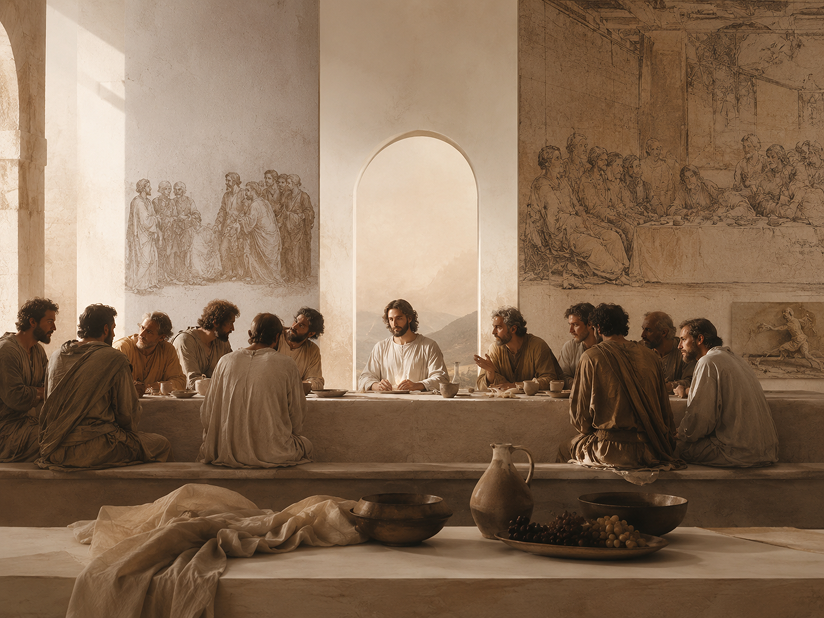

Few scenes in Western art have been represented as frequently as the Last Supper. The image of Jesus seated with his disciples before his arrest and crucifixion has appeared in paintings, mosaics, prints, sculptures, illuminated manuscripts, and contemporary installations.
The subject remains powerful because it contains several stories at once. It is a shared meal, a moment of spiritual significance, an announcement of betrayal, and the beginning of a profound sacrifice. Artists throughout history have returned to this scene because of its emotional complexity and its ability to speak about faith, loyalty, fear, community, and loss.
The biblical event describes the final meal Jesus shared with his disciples. During the meal, he announced that one of them would betray him. This statement transformed an intimate gathering into a moment of tension and uncertainty.
For artists, the challenge has always been to show both the unity of the group and the individual emotional reactions of each disciple. The scene must feel communal, yet every figure should appear to experience the announcement differently.
Leonardo da Vinci's interpretation became the most influential version of the subject. Painted in the late fifteenth century in the convent of Santa Maria delle Grazie in Milan, the work presents the moment immediately after Jesus declares that one of the disciples will betray him.
Leonardo arranged the disciples in groups of three, creating visual order within the emotional chaos. Their gestures, facial expressions, and positions reveal shock, disbelief, anger, and confusion. Some lean toward one another, while others pull away. The composition creates movement across the table while keeping Jesus at its calm center.
Perspective plays a central role. The architectural lines of the room lead toward the head of Jesus, making him the visual and spiritual focus of the painting. The window behind him creates a natural halo effect without the use of a traditional golden circle.
This combination of mathematical structure and psychological drama is one reason Leonardo's work became so important. He did not simply illustrate the event. He transformed it into a study of human emotion.
Judas, the disciple who will betray Jesus, is not separated completely from the group. Instead, he sits among the others, partly in shadow. This choice makes the betrayal feel more disturbing because it comes from within the community rather than from an obvious outsider.
Leonardo's Last Supper became a model for generations of artists. Yet later interpretations often emphasized different aspects of the scene.
Gustave Doré, the nineteenth-century French artist known for his dramatic illustrations, approached biblical subjects with theatrical intensity. His images often feature powerful contrasts between light and darkness, monumental architecture, and emotionally charged figures.
In Doré's visual world, biblical events appear vast and almost cinematic. Light is not only a natural element but a symbol of revelation, holiness, or divine presence. Darkness can suggest danger, uncertainty, or human weakness.
While Leonardo's Last Supper is structured around balance and controlled psychological tension, Doré's approach emphasizes atmosphere. His biblical compositions make the viewer feel that they are witnessing an event of enormous spiritual and historical importance.
The contrast between these artists reveals how the same subject can be transformed through different visual languages. Leonardo invites us to study the reactions of the disciples and understand the scene through gesture and composition. Doré surrounds the viewer with drama, shadow, and spiritual intensity.
Other artists have also reimagined the Last Supper in distinctive ways. Some placed the figures in contemporary clothing or local settings. Others changed the arrangement of the table, emphasized the ritual of bread and wine, or focused on the isolation of Jesus.
In the modern and contemporary periods, artists began to use the Last Supper to explore questions beyond its traditional religious meaning. The scene became a framework for discussions about identity, politics, social exclusion, community, and cultural memory.
Contemporary artists may reinterpret the figures, change their gender or ethnicity, or replace the traditional setting with a modern environment. These choices do not necessarily reject the original story. Instead, they demonstrate how its themes continue to apply to new generations.
The Last Supper is especially suited to reinterpretation because its structure is immediately recognizable. A central figure, a long table, and a group gathered for a final meal are enough to evoke the historical tradition. Artists can preserve this basic structure while transforming almost every other element.
Material also changes the meaning of the scene. In painting, color and perspective may create depth. In printmaking, contrast and line become central. In carved wood, the figures possess physical weight and emerge from the surface. When gold leaf is added, light becomes part of the composition.
A carved interpretation of the Last Supper creates a different relationship with the viewer. The figures are not only represented visually; they occupy real space. Their clothing, gestures, faces, and surroundings can be experienced through texture and depth.
Gold can highlight the most significant parts of the scene. It may draw attention to Jesus, the curtain, the architecture, or symbolic details. As the light changes, the gold appears to move, creating a sense of life within the still composition.
The craftsmanship of such a work also connects it with older religious traditions. Medieval altarpieces, Byzantine icons, and illuminated manuscripts frequently used gold to separate sacred space from ordinary reality. A contemporary use of gold leaf can recall this history while creating a new visual experience.
Every interpretation of the Last Supper participates in a long artistic conversation. The artist must decide which moment to represent, how to arrange the figures, where to place Judas, and how to guide the viewer's attention.
These decisions reveal how the artist understands the story. Is it primarily a scene of fellowship, betrayal, sacrifice, grief, or spiritual transformation?
The Last Supper continues to inspire artists because it is both historical and timeless. It belongs to a particular religious tradition, yet its emotional themes are universal. Most people understand the experience of gathering around a table, trusting others, fearing loss, or discovering betrayal.
From Leonardo's carefully constructed perspective to Doré's dramatic atmosphere and today's material experimentation, the subject remains alive. Each generation sees something different within it.
The lasting importance of the Last Supper lies not only in the story itself but in its ability to hold many meanings at once. It reminds us that great art does not provide a single final answer. Instead, it creates a space in which history, faith, emotion, and personal interpretation can meet.